Looking isn't neutral: the hazards of dark web research and the law that doesn't care why you're there
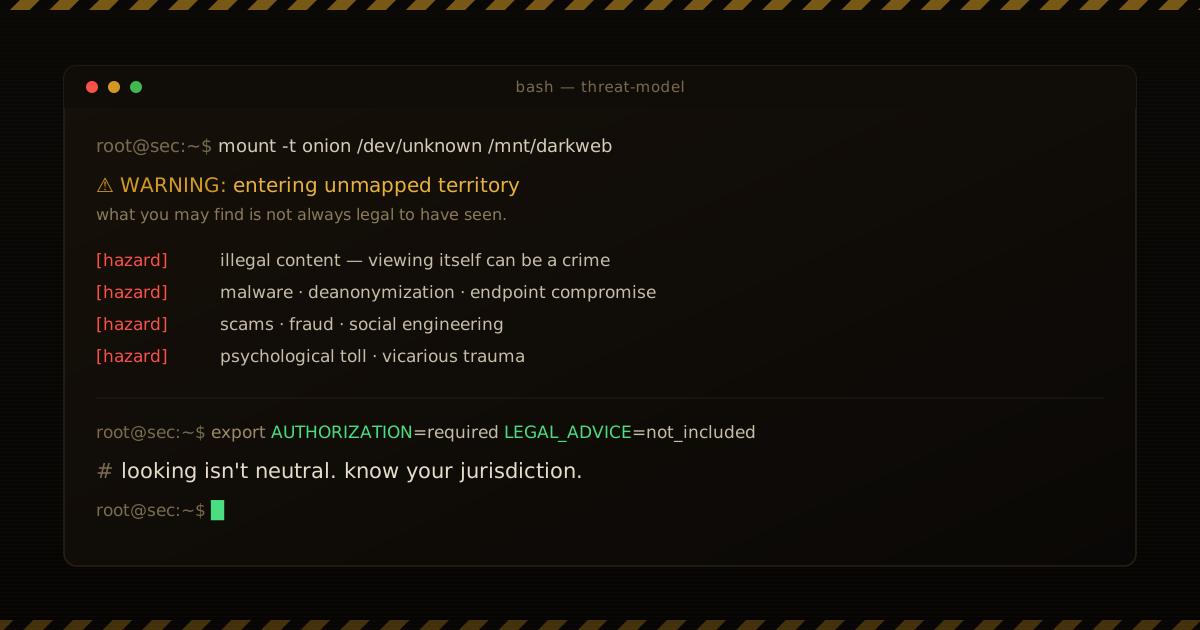
There’s a romance to the phrase “dark web research” that the actual work does not support. The mental image is a hoodie and a wall of green text. The reality is closer to handling unlabelled chemicals: most of it is inert, some of it will hurt you, and a small fraction is a felony to have touched — and the label doesn’t tell you which is which until you’re already holding it.
This post is the safety sheet. It’s about what you may find, why finding it is a problem, how the law treats you regardless of your intentions, and how to do this kind of work without ending your career or your case over it. It is deliberately not an access guide. If you’re looking for how to get somewhere, this is the wrong post; if you’re looking for why you might not want to, read on.
This is not legal advice. I’m a researcher and a journalist, not your lawyer. Laws vary enormously by jurisdiction and change over time. Treat everything below as orientation, not authority, and get qualified counsel in your own jurisdiction before you do anything that touches these lines.
cat table_of_contents.txt- Deflating the mystique
- What you may find
- The one category that breaks the “looking isn’t illegal” rule
- The dangers to you, the researcher
- The law doesn’t care why you’re there
- If you stumble onto something illegal
- Harm reduction
- Legal disclaimer
- Sources (defanged)
Deflating the mystique
The “dark web” is mostly Tor onion services — sites reachable only through the Tor network, which anonymises routing. That’s it. The network and the browser are legal to use in most of the world; the Tor Project is a registered US nonprofit and the software is distributed freely. Browsing an .onion site is not, in itself, a crime in the US, the UK, or across the EU. The governing principle everywhere sane is the same: the crime is the act, not the tool — using Tor to commit an offence doesn’t insulate you from prosecution for that offence, and using it to read a page generally isn’t one.
Hold onto that principle, because there is exactly one place it stops applying, and it’s the most important paragraph in this post. We’ll get there.
What you may find
Unstructured poking-around surfaces a predictable hazard taxonomy. Ranked roughly by how much trouble each can cause a researcher:
- Content that is illegal to view or possess. The category that ends careers and liberty. Covered in its own section below because it does not behave like the others.
- Stolen data. Combolists, breach dumps, leaked databases, medical and financial records. Downloading or retaining this can constitute possession of stolen information or trafficking, depending on jurisdiction and content — a documentation screenshot and a local copy of 4GB of SSNs are not the same legal object.
- Malware and exploit kits. Frequently the “product” and frequently boobytrapped. Sites and files in this space assume a hostile visitor and are built to compromise one.
- Violent and extremist material. Some of it illegal to possess in some jurisdictions (extreme-content and terrorism statutes vary widely), all of it a psychological hazard.
- Fraud and scams. A large share of what’s advertised is a scam targeting other criminals — and, cheerfully, targeting researchers too. Nothing here is trustworthy by default.
- Live criminal services. Marketplaces, hire-a-thing listings, and other services where mere interaction can shade from observation into participation faster than you expect.
The through-line: the further you get from read-only observation of publicly posted text, the faster you accumulate legal and technical risk. Interaction is where observation becomes involvement.
The one category that breaks the “looking isn’t illegal” rule
Everything above about “the crime is the act, not the tool” has a hard exception, and it is not a grey area. Child sexual abuse material (CSAM) is a separate, serious crime to access, view, or possess in nearly every jurisdiction — regardless of intent, regardless of whether you downloaded anything, regardless of whether you’re a researcher. “I was documenting it” is not a recognised defence in most places, and ignorance of what you were about to load is not a defence either.
So the rules for this category are absolute and non-negotiable:
- Never seek it. There is no research justification that makes seeking it lawful or ethical. Full stop.
- If you encounter it accidentally, disengage immediately. Close it. Do not download, screenshot, save, catalogue, or “verify” it. Every one of those actions can convert an accident into a possession offence.
- Report it to the appropriate authority — in the US, the NCMEC CyberTipline; in the UK, the Internet Watch Foundation; elsewhere, your national hotline or law enforcement. Reporting promptly is both the right thing and, in several jurisdictions, part of how you protect yourself. Staying silent can implicate you.
- Document that you reported, not what you saw.
This is the paragraph to internalise before any of the rest. The rest of this post is about managing risk. This part isn’t a risk to manage; it’s a line not to cross, even by accident, and a protocol for the accident.
The dangers to you, the researcher
Beyond the content itself, the act of research carries its own exposure:
Legal exposure. Covered in full below, but the headline: your intent protects you far less than you think, and in some categories not at all.
Technical compromise and deanonymization. This is adversarial territory that assumes every visitor is a target. Malicious onion services, hostile scripts, and tracking that exploits a misconfigured browser or a leaky VM can unmask you or own your endpoint. The people running these sites are, definitionally, comfortable breaking into computers.
Scams and social engineering. You are a mark. Researchers get phished, baited into transactions that criminalise them, and fed fabricated “leaks” designed to get a credulous writeup published. Which loops directly back to house rule #1 — evidence over vibes. A screenshot is a claim, not proof.
Psychological toll. This one gets skipped and shouldn’t. Sustained exposure to the worst of what humans post is a genuine occupational hazard; content moderators and investigators experience measurable vicarious trauma. If your research plan doesn’t include exposure limits and a way to decompress, it’s incomplete. Burnout and desensitisation are failure modes, not badges.
Attribution and reputation. In some jurisdictions, an arrest — not a conviction — carries downstream consequences: loss of visa-free travel to certain countries, effects on credit, higher insurance, a public record that follow-on employers’ background checks will surface. The process is part of the punishment.
The law doesn’t care why you’re there
Here’s the honest jurisdictional picture. It is general, and it is not advice.
The tool is legal; the conduct is what’s judged. In the US, no federal statute bans downloading Tor, using the network, or visiting .onion sites. Federal law targets specific activities — trafficking, fraud, possession of illegal content — not the use of a privacy tool. The UK (Computer Misuse Act 1990) and the EU take the same line: browsing onion sites is not itself “unauthorised access.”
The US CFAA and the “good faith” caveat. The Computer Fraud and Abuse Act criminalises unauthorised access and exceeding authorised access to protected computers. In May 2022 the DOJ revised its charging policy to say it should decline to prosecute good-faith security research even where it technically violates the CFAA — and, following Van Buren v. United States (2021), that merely violating a website’s terms of service isn’t a federal crime absent breaching a technical barrier. Two large caveats you must not gloss over: it is internal DOJ policy, not law — it doesn’t bind courts, can be rescinded by a future administration, and offers no protection from civil suits — and it explicitly does not cover bad-faith actors merely claiming to be researchers. “I’m a researcher” is a posture the facts have to support, not a password.
“Looking” has an exception, and it’s the one above. The general rule that viewing without transacting is not itself criminal holds for most content — and evaporates for CSAM and, in some jurisdictions, certain extreme or terrorism-related material, which are illegal to view or possess regardless of intent. The UK is explicit that viewing prohibited material can be prosecuted, that ignorance of the law is not a defence, and that you should report anything you stumble onto.
Accessing illegal content without transacting is a genuine grey area that varies by jurisdiction — the journalist documenting a market’s existence without buying anything sits in a different, murkier place than the buyer, but “murkier” is not “safe.”
Authorization is the cleanest protection you have. Written scope, a defined lawful purpose, and — for anything touching live systems — documented authorization move you from “hoping a policy holds” to “standing on a contract.” It is not a magic shield, but it is the difference between good-faith research you can evidence and a story you’ll be telling to an investigator.
The meta-point: build your threat model around the assumption that your intentions are legally irrelevant until you can prove them, and that in at least one category they don’t matter at all.
If you stumble onto something illegal
A short, memorised protocol beats improvisation when your pulse spikes:
- Stop. Close the resource. Don’t download, save, or screenshot illegal content to “prove” it.
- Don’t share it — not to a colleague, not to a group chat, not “just to confirm.” Redistribution is often a heavier offence than possession.
- Report to the appropriate body (see the CSAM section and Sources). For other illegal material, national law enforcement or the relevant hotline.
- Document your response — timestamp, what you did, that you reported — not the material itself.
- Get counsel if you’re unsure of your exposure. Earlier is cheaper than later.
Harm reduction
For legitimate, authorized work, a defensive posture — stated as principles, not a setup tutorial:
- Authorization and scope first. Written purpose, defined boundaries, and legal sign-off for anything beyond passive reading of public postings. If you can’t articulate the lawful purpose in a sentence, stop.
- Isolate everything. Dedicated, disposable, isolated environments — never your daily-driver machine or identity. Assume the environment will be attacked and build so that a compromise is contained and survivable.
- Observe; don’t acquire. Default to read-only. Don’t download, don’t transact, don’t retain more than your documented purpose requires — and never retain anything illegal to hold. The lightest footprint is the most defensible one.
- Log your own conduct. Contemporaneous notes of what you did and why are both good method and, if it ever matters, evidence of good faith.
- Protect your head. Exposure limits, scheduled breaks, and a real off-ramp for the psychological load. This is a control, not a luxury.
- Know your reporting obligations before you start, not after you trip over them.
None of this is exotic. It’s the difference between research you can defend and a liability you’re carrying without knowing it.
Legal disclaimer
The following is general information for educational and defensive-research purposes. It is not legal advice and does not create any advisor relationship. Laws governing network access, computer misuse, data possession, and prohibited content differ substantially between — and sometimes within — countries, and they change. What is lawful passive research in one jurisdiction may be an offence in another, and some categories of material are unlawful to access or possess everywhere, irrespective of intent or professional purpose. Nothing here authorises any activity, and no policy or custom described here guarantees immunity from criminal or civil liability. Before conducting research that may touch these areas, obtain advice from a qualified lawyer licensed in your jurisdiction, and where applicable, written authorization for your specific scope. You are responsible for your own conduct and for knowing the law that applies to you.
Sources (defanged)
- hxxps://www[.]eff[.]org/issues/coders (EFF — coders’/researchers’ legal FAQ)
- hxxps://www[.]justice[.]gov/jm/jm-9-48000-computer-fraud (DOJ Justice Manual §9-48.000 — CFAA charging policy)
- hxxps://www[.]supremecourt[.]gov/opinions/20pdf/19-783_k53l[.]pdf (Van Buren v. United States)
- hxxps://www[.]legislation[.]gov[.]uk/ukpga/1990/18/contents (UK Computer Misuse Act 1990)
- hxxps://report[.]cybertip[.]org/ (US — NCMEC CyberTipline)
- hxxps://www[.]iwf[.]org[.]uk/ (UK — Internet Watch Foundation)
- hxxps://www[.]torproject[.]org/ (Tor Project — what the network is and isn’t)